
The Ajrakh Dupatta You Almost Scrolled Past Could Be the Most Meaningful Thing You'll Ever Wear
- por {{ author }} India Scarves
-
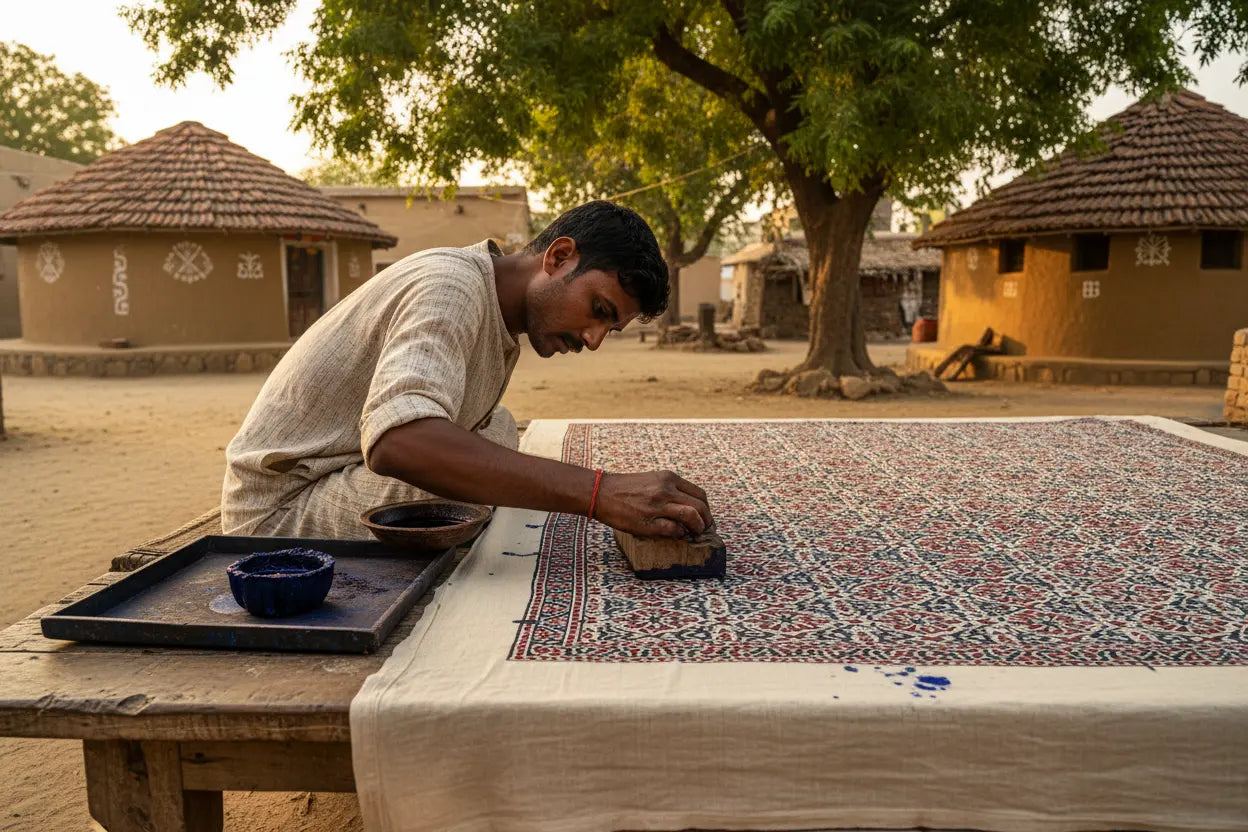
Somewhere in the sun-bleached salt flats of Kutch, Gujarat, a man is kneeling over a length of cotton cloth. His name doesn't appear on any fashion week programme. His face won't grace a magazine cover. But the work his hands are doing right now — pressing a hand-carved teak block into fabric with the precision of a surgeon and the patience of a monk — is older than the Parthenon, older than the Roman Empire, older than almost every art form that humans have managed to keep alive.
He is printing Ajrakh.
And the stole, scarf, or dupatta that emerges from this ritual of wood, water, and natural dye is not something a machine can replicate, a fast-fashion factory can imitate, or an algorithm can design. It is singular. Unrepeatable. Alive with human intention.
If you've never owned one, this is your sign.
What Exactly Is Ajrakh — and Why Should You Care?
Ajrakh is not just a "print." Calling it that would be like calling the Taj Mahal "a building." Ajrakh is a centuries-old resist-printing and natural-dyeing tradition that involves up to sixteen separate stages of washing, mordanting, printing, dyeing, drying, and printing again — sometimes stretching over two to three weeks for a single length of cloth.
Every colour you see on an Ajrakh textile was pulled from the earth itself:
- Deep indigo — fermented from the leaves of the Indigofera plant over several days, creating that soul-stirring blue that ancient civilisations across the world considered sacred.
- Rich crimson — extracted from the root of the madder plant, dried, powdered, and coaxed into fabric through alum mordants.
- Warm earth tones — achieved through iron rust, pomegranate rinds, and tamarind seed solutions.
No petrochemicals. No synthetic shortcuts. Just plant, mineral, and craft knowledge passed down through generations of the Khatri artisan families who have been the custodians of this art since their ancestors practised it in the ancient Indus Valley civilisation.
When you drape an Ajrakh dupatta over your shoulders, you are wearing chemistry that predates the periodic table.
The Hidden Language on Your Shoulders
Here is something that will change the way you look at every Ajrakh piece forever.
Those hypnotic geometric patterns? They are not decorative filler. They are a cosmological map.
The central motif you'll find on most traditional Ajrakh textiles is called the trefoil — three interlocking sun discs that represent the eternal bond between the sun, water, and earth. Around it, artisans carve lattices of stars, flowers, leaves, and abstract grids that echo the architecture of Mughal gardens and the mathematical precision of Islamic jali screens.
Every single motif is a meditation on the relationship between the human world and the natural world. When the artisan presses his block into the cloth, he is not merely decorating fabric. He is mapping the cosmos onto cotton.
So the next time someone compliments your Ajrakh stole and asks, "Where did you get that?" — you can tell them you're wearing a small piece of the universe.
One Stole. Seven Days. Infinite Possibilities.
One of the biggest myths about Ajrakh is that it belongs only to "traditional" outfits. Nothing could be further from the truth. The deep indigos, earthy reds, and geometric precision of Ajrakh are astonishingly versatile.
- Monday — The Power Meeting: Drape an indigo Ajrakh stole over a white linen blazer and black trousers. The structured geometry of the print reads as sharp and intentional.
- Tuesday — The Casual Coffee Run: Loop an Ajrakh scarf loosely around the neck of a plain grey t-shirt and jeans. One accessory. Entire outfit: transformed.
- Wednesday — The Festive Lunch: Pair a rich crimson Ajrakh dupatta with a simple kurta in ivory or sage green. Let the dupatta do all the talking.
- Thursday — The Zoom Call: An Ajrakh scarf draped over one shoulder turns a basic top into a conversation starter, even through a laptop screen.
- Friday — Date Night: An Ajrakh stole thrown over a little black dress is the kind of contrast that makes people look twice. Heritage meets edge.
- Saturday — The Weekend Market: Tie an Ajrakh scarf as a headband or wrap it loosely as a belt over a cotton dress. Effortless. Cool.
- Sunday — The Do-Nothing Day: Wrapped around you on the couch with a book and chai, an Ajrakh dupatta becomes the softest, most beautiful comfort blanket you own.
The Slow Fashion Argument You Can Actually Wear
An Ajrakh stole from a genuine artisan-backed store is the antithesis of everything wrong with fast fashion:
- The dyes are plant-based and biodegradable.
- The process is water-conscious, using natural mordants refined over millennia.
- Your purchase is someone's livelihood — a person, a family, a community of artisans in Kutch and Barmer.
When you buy Ajrakh, you are not just making a fashion choice. You are casting a vote for the kind of world you want to live in.
Why Ajrakh Ages Like Wine
Unlike synthetic prints that crack and fade after a few washes, natural-dyed Ajrakh textiles undergo a gentle transformation with every wash. The indigo deepens and mellows. The reds soften into rich, warm tones. The fabric relaxes, becoming increasingly fluid and buttery against the skin.
The Ajrakh dupatta you buy today will look different in a year. Not worse. Better. More lived-in. More yours.
The Gift That Says More Than a Gift Card Ever Could
An Ajrakh stole or scarf might be the most thoughtful thing you've ever gifted. It works for birthdays, Diwali, Eid, and weddings. It works because it is beautiful, useful, and loaded with a story worth telling.
Your Ajrakh Is Waiting
Every piece in the India Scarves Ajrakh Collection has been through a journey more remarkable than anything in your wardrobe. Washed in rivers, dried under open skies, printed by hand with blocks carved from teak, and dyed with colours pulled from roots, leaves, and minerals.
It has been touched by more human care in its making than most of us experience in a month.
And now it's waiting for you.
→ Explore the Ajrakh Collection at India Scarves
Every purchase supports traditional artisan communities in Gujarat and Rajasthan. Natural dyes. Handmade craft. Delivered to your door.


Please upload banner from store admin blog pages